02 Learning the Language
Three artists who learned a dominant visual language from outside it: Osman Hamdi Bey in the Met’s Orientalism, then two shows in one building on East 66th Street, Cossette Zeno arriving in Breton’s Paris at Richard Saltoun and Esphyr Slobodkina helping found American abstraction at Rosenberg & Co.
The Met’s Orientalism: Between Fact and Fantasy is about who gets to make the picture of a place. It is the Met’s first exhibition on the subject and the first major collaboration between its European Paintings and Islamic Art departments. It ends with Osman Hamdi Bey, an Ottoman painter who worked in the European genre that had been used to picture his world, and who staged his compositions by photographing himself in costume. The question he leaves open is what happens when an outsider learns the dominant language well enough to speak it back. Two galleries in a single building on East 66th Street, a short walk south of the Met, take up the same question from other directions. At Richard Saltoun, Cossette Zeno: San Juan to Paris follows a painter born in Santo Domingo in 1930 and raised in Old San Juan, who moved from Puerto Rico’s avant-garde to André Breton’s Surrealist circle in post-war Paris. The gallery calls her a significant yet overlooked figure, and the show reunites work from those years for the first time in North America. At Rosenberg & Co., Esphyr Slobodkina, a Russian-born painter, became a founding member of the American Abstract Artists in 1936 and made hard-edged, planar abstraction for the rest of her life, while the wider world mostly knew her as the author of Caps for Sale. Both women came to the center of a movement from its edge, and both were filed away afterward as footnotes, one to Surrealism and one to children’s books. The Met’s rooms show how a dominant culture pictured others. These two shows take up the next question: what those others made once they had the brushes.
- 01Cossette ZenoRichard Saltoun · 19 E 66th StreetCloses Oct 30
- 02Esphyr SlobodkinaRosenberg & Co. · 19 E 66th StCloses Nov 14
- 03OrientalismMetropolitan Museum of Art · 1000 Fifth AvenueCloses Feb 28
Orientalism
The Met’s first exhibition dedicated to Orientalism, and the first major collaboration between its departments of European Paintings and Islamic Art.
About 180 objects from twelve Met departments, plus rarely seen loans. The paintings include Gérôme, Delacroix, Ingres, John Frederick Lewis and Sargent, with Bashi-Bazouk, the life-size painting of an Ottoman mercenary long favored by Met visitors, seen in new company. They hang among metalwork, ceramics, glass and textiles from the Islamic world. Sections run from “France in Egypt: Power through Knowledge” and “The Alhambra: Gateway to Orientalism” through “Hard and Soft Power: Orientalism and Design” to “Osman Hamdi Bey: Depicting the Orient as an Insider.”
The Met could have hung its Orientalist paintings as a guilty pleasure with a warning label. Instead it hangs them next to the things they borrowed, the metalwork, ceramics, glass and textiles that dealers moved and painters used as props, and lets the traffic show. The most revealing detail is commercial. The fashion ran so deep, curator Maryam Ekhtiar notes, that “many designers and manufacturers marketed their creations as ‘Persian,’ regardless of where they were actually made.” The label was the product.
Then the show turns. Osman Hamdi Bey, the insider the last section is named for, often “donned costumes and photographed himself to prepare his paintings.” He used a European genre to picture his own world and staged the picture with a camera, playing his own model. The show doesn’t settle whether that is resistance or absorption, and it shouldn’t. It is the best argument in the building about who authorizes an image of a place. It rewards a slow, argumentative visit, and it runs through February 28.
The month’s sharpest institutional argument: a picture of a place is a claim about it, and someone authorized the claim.
Cossette Zeno
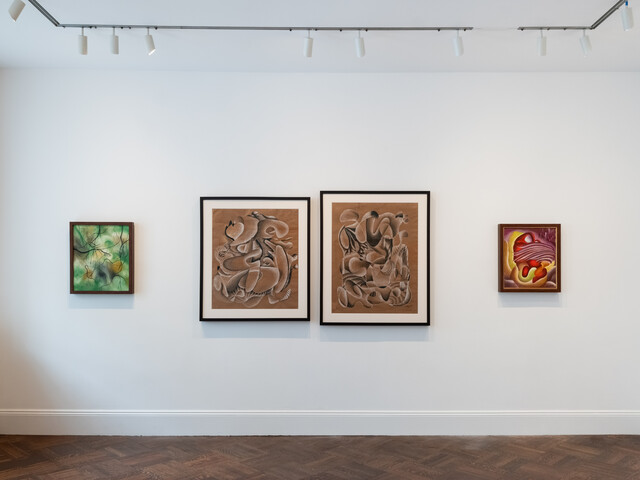
Cossette Zeno, born in Santo Domingo in 1930 and raised in Old San Juan, Puerto Rico, a Surrealist whose work appeared in Surrealism Beyond Borders at The Metropolitan Museum of Art and Tate Modern.
Work from the few years when Zeno moved from Puerto Rico to Paris. Reunion 1 (1952) is oil crayon on kraft paper. An Uncomfortable Chair is watercolor and ink, and Tropical Haze is oil on canvas. In 1953 her teacher Eugenio Fernández Granell secured her a postgraduate scholarship to Paris, where she joined the Surrealist circle around André Breton.
Those Paris years are the hinge of the show. Zeno arrived from the Caribbean in a movement that often borrowed its imagery from places like the one she came from, and she joined it as a working member rather than as a subject. The gallery calls her “a significant yet overlooked figure within Caribbean and international Surrealism,” and the overlooking is part of the story: the work was made at the center and then left at the edge.
Read next to the Met’s Osman Hamdi Bey, the show makes the same point from the other side of a century. An outsider who masters the dominant idiom still has to fight to be counted in its history. The small scale and humble materials, oil crayon on kraft paper among them, make that fight feel close.
An outsider learns the dominant idiom and joins the movement: the Met’s question, carried into the twentieth century.
Esphyr Slobodkina
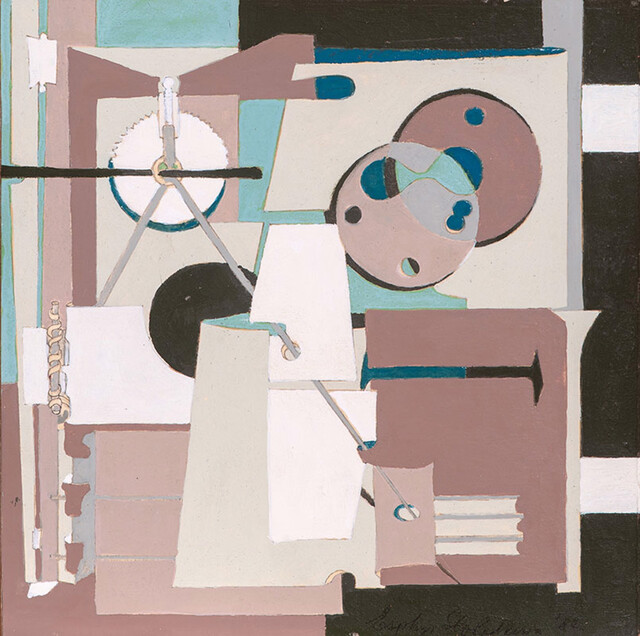
Esphyr Slobodkina, born in 1908 in Chelyabinsk, Russia, who died in 2002 in Glen Head, New York. She was a founding member of the American Abstract Artists group in 1936.
Paintings from across her long career, among them Copper Interests (Copper Treasures) (1948) and Looking Backwards (1982). The gallery calls her a forerunner of hard-edge painting, built from juxtaposed planar shapes.
In 1940 Slobodkina published Caps for Sale, which the gallery notes “remains a best-selling storybook,” and the book has long eclipsed the paintings. The show puts the proportions right. Her abstraction is crisp, interlocking and flat, and it was there at the founding: she helped start the American Abstract Artists in 1936, the same group Perle Fine joined a decade later. Fine anchors this month’s second Chelsea walk.
The real subject of the show is the tension between the picture-book author and the hard-edge painter. In the end the two were never separate. Both work with flat, legible shapes that hold a story without telling it.
Another arrival at the center: a founder of American abstraction remembered mostly for a children’s book.