04 Kitchen Foil and Bone Black
Four stops tied together by their humblest materials: Maggi’s pencil on kitchen foil, McIntyre’s pours over bone black and bubble wrap, Wilkinson’s bare linen standing in for painted linen, and eighteen artists over seventy-five at Marc Straus who are still making new work.
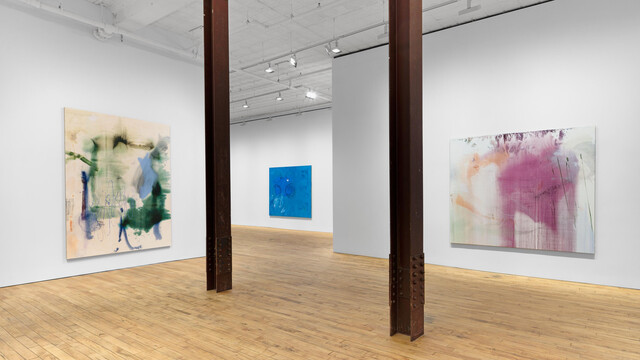
Cheap materials tie together the four stops between Walker Street and Grand Street. At Bienvenu Steinberg & C, Marco Maggi marks the smooth side of Reynolds kitchen foil with a 4H pencil and slices an apple down its axis. Across Walker Street at David Zwirner, Emma McIntyre pours paint over bone black, a pigment made from charred animal bones, and presses bubble wrap into it while it is wet. At P·P·O·W, in fluorochiaroscuro, Michael Wilkinson leaves patches of linen bare so the canvas plays both the material and its own picture. And at Marc Straus, in a show of eighteen women artists all over seventy-five, Judy Pfaff recalls a year spent working in aluminum foil to “exorcise Richard Serra” from a loft that had been his studio. None of this is thrift. Each artist takes a material whose usual job is to disappear, as wrapping, ground or support, and makes it the thing to look at. Maggi’s marks sit right at the edge of visibility, in a vocabulary the gallery calls “devoid of any symbolism or signification.” McIntyre’s surfaces keep the literal print of whatever touched them, her own body included. Wilkinson paints photographs of flowers set against linen, on linen. On this walk the surface admits what it is made of. Marc Straus is a different kind of stop: a survey of current work that insists it is “not a retrospective.” It is uneven by design, eighteen practices rather than one argument. The best moments are the ones still taking risks rather than restating a famous earlier one. Look for Jeanne Silverthorne’s cast-rubber baby on a melting white platform and Martha Rosler’s long-running collapse of the American living room into images of war.
- 01The Prime of Your LifeMarc Straus · 299 Grand StreetCloses Oct 31
- 02fluorochiaroscuroP.P.O.W · 392 BROADWAYCloses Oct 24
- 03Emma McIntyreDavid Zwirner · 52 Walker StreetCloses Oct 24
- 04Higher PerplexityBienvenu Steinberg & C · 35 Walker StreetCloses Nov 14
Emma McIntyre
Emma McIntyre, born in Auckland in 1990 and based in Los Angeles, in her third solo show with David Zwirner.
New paintings and works on paper, all made in 2026. The paint is poured rather than brushed and mixed with oxidized iron and copper. Bubble wrap pressed into wet paint leaves a honeycomb grid, a spray bottle leaves rings of stain, and prints of the artist’s body sink into pools of color. Crackle and drag pours white over a ground of bone black. Beautiful old lies carries a mark taken directly from an angel’s wing in one of Giotto’s frescoes.
The title comes from Diane di Prima, “this body holds swamp stuff thick viscous life-generating Mud,” and the paintings take the line literally. They are records of contact. Everything that touched the surface left its shape there: the bubble wrap, the spray bottle, the painter. Abstract painting has often hidden its tools. McIntyre lists them.
The Giotto wing gives the game away. A gesture borrowed from Giotto turns up inside a poured field, as if to admit that even the most chance-driven surface is quoting something. This is the most bodily show on the walk, and it risks reading as mere atmosphere. Look for the imprints before the color.
Records of contact: every tool that touched the surface left its shape.
fluorochiaroscuro
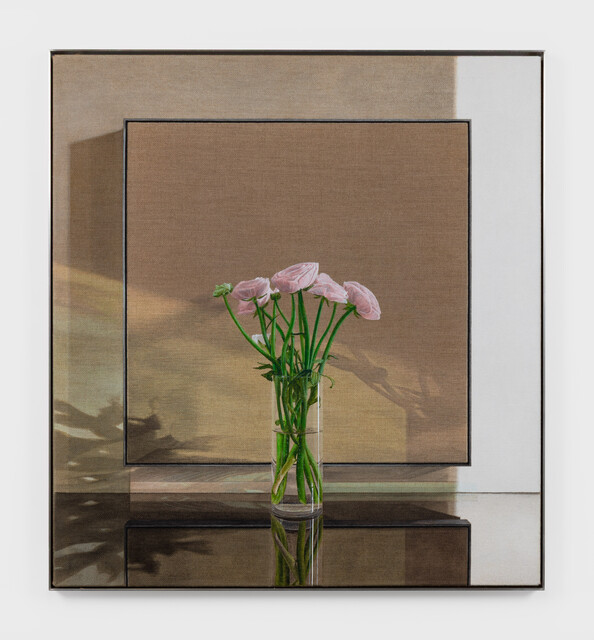
Michael Wilkinson, a Glasgow-based painter born in 1965, in his first solo exhibition with P·P·O·W.
Still lifes in acrylic, among them Delphinium, Ranunculus, Cherry Blossom and Daffodil, painted from photographs of flowers set against stretched linen in thin aluminum frames. The paintings hang in matching aluminum frames, and the linen in the picture is the real linen, left bare. The title names his technique: fluorescent pigment worked into the light and shadow. Delphinium, Delphinium ii and Delphinium iii track one subject across a day.
The show is sharper than its flowers suggest. Wilkinson builds a loop. A real support is photographed, the photograph is painted, and the painting sits on the same kind of support, framed exactly as the photographed one was. Where the canvas is left blank it is “both the material itself, and simultaneously, its representation,” in the gallery’s phrase. The fluorescent pigment pushes the other way and makes the light more artificial than any daylight.
The project began during the pandemic lockdowns, out of what the gallery calls “a prolonged sense of a suspended, decelerated reality.” The Delphinium sequence is the payoff: time measured as a change of light on one bouquet.
The surface admits what it is made of: bare linen stands in for painted linen.
The Prime of Your Life
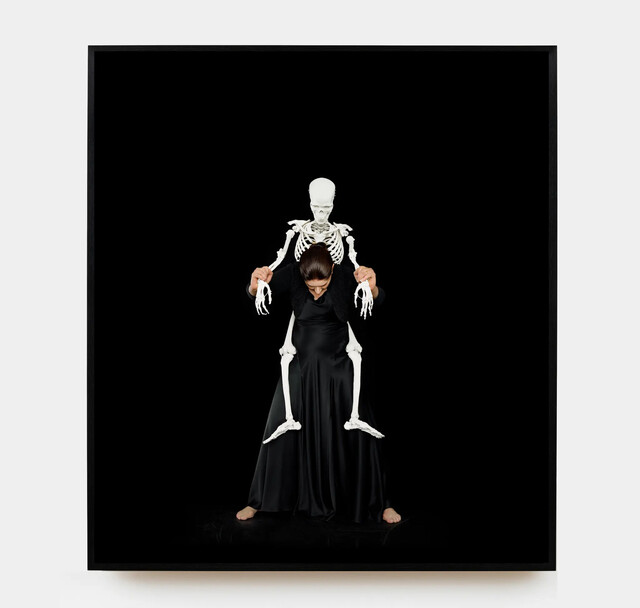
Marc Straus, with a group show of eighteen women artists all over seventy-five, including Lynda Benglis, whose survey anchors this month’s Chelsea walk.
Current work rather than greatest hits, from Rose Wylie, Squeak Carnwath, Mary Heilmann, Frances Barth, Judy Pfaff, Martha Rosler, Jenny Holzer, Judy Chicago, Marina Abramović, Lynn Hershman Leeson and others. Look for Jeanne Silverthorne’s cast-rubber You and Me (2026), a gray baby on a large white platform that seems to be melting. Look too for Rosler’s photomontage series House Beautiful: Bringing the War Home, which she has extended for nearly six decades, and Jenny Holzer’s Truisms.
The premise is a correction. These are careers the market noticed late, if at all; the gallery’s essay points out that the art world didn’t catch on to Rose Wylie “until she was 76.” The show’s own line is that it is “not a retrospective,” and it is strongest where that holds true. The best work on the wall is new and still taking risks. It doesn’t stand in for a famous earlier moment.
Silverthorne’s melting platform is that kind of work. So is Pfaff’s story of a year spent working in aluminum foil to “exorcise Richard Serra” from his old studio. Those are artists still arguing with their materials and their predecessors. Where a piece is only a signature, the show turns into a roll call. Go for the arguments.
Pfaff’s year in aluminum foil, aimed at Serra’s old studio: the same cheap material as Maggi’s, turned on a predecessor.
Higher Perplexity
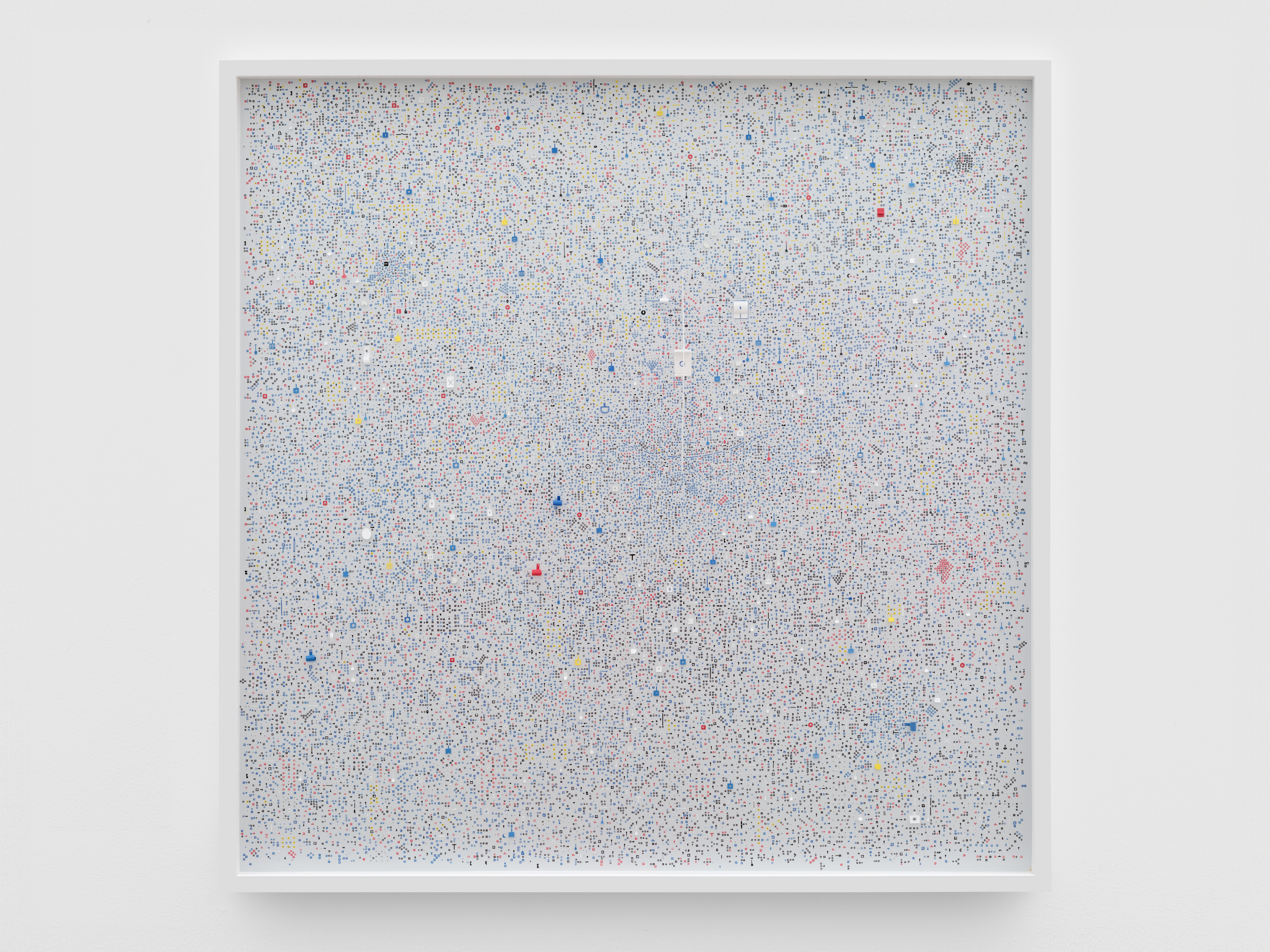
Marco Maggi, born in Montevideo in 1957, who represented Uruguay at the 56th Venice Biennale in 2015. Higher Perplexity is his 11th solo exhibition in New York.
Drawing at the edge of legibility, done on deliberately ordinary supports. In his own account of the show he describes marking “the silky smooth side of a roll of Reynolds kitchen foil with a 4H graphite pencil,” a hand “gliding over Yupo paper,” slicing an apple down its axis, altering the shell of a ping-pong ball, and covering a sheet of Dibond with tiny fragments of acid-free paper. One work, ABEL and CAIN, is a McIntosh apple dated 2004–2026.
Maggi’s marks look like circuitry, city plans or a script nobody can read. The gallery is careful to say they mean nothing in particular. They point instead to “the way information is processed in a global yet increasingly myopic era.” That is the right frame. These are drawings about bandwidth: how much a surface can hold before it turns into noise, and how close a viewer has to come before the noise resolves.
The supports are pointedly generic, foil and apple and ping-pong ball, so what remains to read is the process. Give it time. The work does nothing at a distance and a great deal up close.
Kitchen foil and a 4H pencil: the walk’s cheapest material carries its most exacting work.