03 The Rule and the Remembering
What happens between an instruction and its result: Harold Cohen’s drawing machine at Gazelli, Matthew Ronay’s plinths built from a misremembered Frank Lloyd Wright fireplace, Eric Uhlir scraping half of every painting away, and Perle Fine’s gesture laid over a lifelong grid.
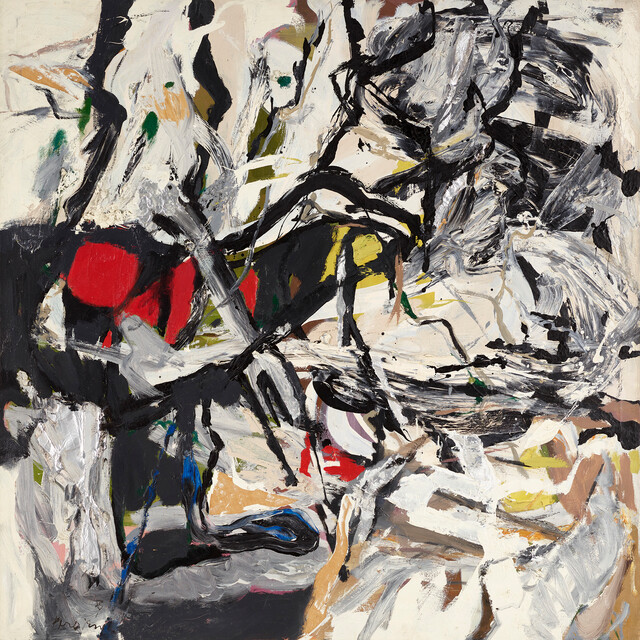
This walk is about the space between an instruction and its result. At Gazelli Art House’s new Chelsea gallery, Harold Cohen is there as the inventor of AARON, one of the earliest computer programs designed to make paintings and drawings autonomously. The show includes a drawing from his Drawing Machine period and a work whose dyes his Painting Machine applied. Cohen wrote the rules and the machine made the marks. The work on the wall belongs fully to neither. Two other stops swap the machine for memory. At Casey Kaplan, Matthew Ronay’s plinths are built from his memory of a fireplace at Frank Lloyd Wright’s Hollyhock House. They come from the memory, not the fireplace, with all the “distortions of recollection, where the mind stretches, compresses, and invents images.” At Winston Wächter, Eric Uhlir builds each painting up and scrapes half of it away, which he calls “a reflection of how our memory works.” Memory, on this walk, is another machine that follows rules and edits as it copies. Perle Fine anchors the walk at Berry Campbell, and she fits this argument better than her Abstract Expressionist label suggests. The earliest works in the show, from the mid-1940s, are grids, and the grid stayed with her for life. Wall of Silence, the fourteen-foot diptych from 1961, lays sweeping gesture over geometric fields, so the rule stays visible under the freedom. Prince Street Gallery’s two-artist show changes the key at the end of the walk: images made in service of a book and a cause rather than a system.
- 01Cold Meat, Cake, and a Variety of All the Finest Fruits in Season;Casey Kaplan · 121 W 27th StCloses Oct 24
- 02Eric Uhlir | The Long LightWinston Wächter Fine Art · 530 W 25th StCloses Oct 31
- 03Put the Kettle OnGazelli Art House · 545 W 25th StCloses Oct 31
- 04Perle FineBerry Campbell Gallery · 524 W 26th StreetCloses Oct 24
- 05FLAVIA BACARELLA and RANI CARSONPrince Street Gallery · 547 West 27 StreetCloses Oct 31
Perle Fine
Perle Fine (1905–1988), an Abstract Expressionist who joined the American Abstract Artists in 1946 and was one of the eleven women in the 1951 Ninth Street Exhibition, the show that gathered the artists who would define the New York School. This is her third exhibition at Berry Campbell.
Fifteen paintings and works on paper from the 1940s to the early 1960s. The earliest, Soft Spot (1945) and Bristling (1946), work through the grid. Several paintings come from the early-1950s Prescience Series, softer and more atmospheric. The centerpiece is Wall of Silence (1961), a diptych about fourteen feet long, shown with Aftermath of a Sweeping Storm (1958) and Pounding Surf (1959).
Fine usually gets told as a recovery story, a woman of the New York School overlooked beside the men around her. The story is true, and the paintings make a more specific case than it does. The gallery notes that the Prescience paintings anticipated Color Field “by almost a decade,” and the early grids show where her gesture came from. It didn’t come from nowhere. It came out of a structure she kept testing for the rest of her career.
Wall of Silence is the place to stand. At fourteen feet it is big enough to rearrange the body in front of it. The sweep of the brush works against the geometric fields without erasing them. That tension between the rule and the release is the subject of this whole walk, and Fine got there first.
The anchor: a grid kept for a lifetime, with gesture laid over it.
Cold Meat, Cake, and a Variety of All the Finest Fruits in Season;
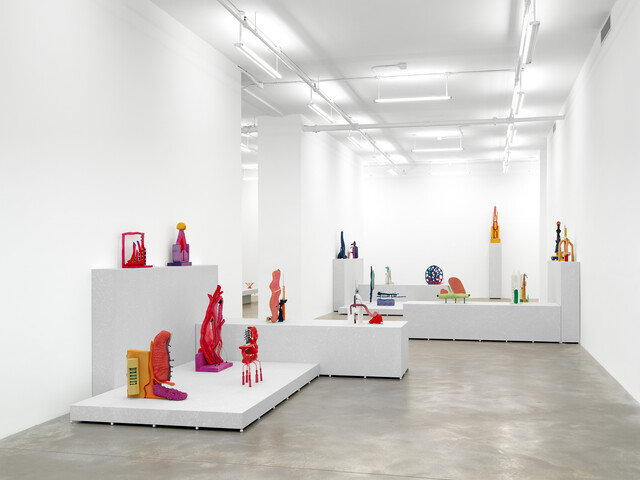
Matthew Ronay, a sculptor of carved basswood forms, in his fourth solo exhibition at Casey Kaplan.
More than thirty small basswood sculptures on artist-made plinths, grouped into tableaux. The plinths exaggerate and abstract the fireplace at Frank Lloyd Wright’s Hollyhock House as Ronay remembers it, their surfaces treated to look like concrete. The layout borrows from René d’Harnoncourt’s installations at MoMA, which he directed from 1949 to 1967, so no straight path runs through the room. The title comes from a passage in Pride and Prejudice describing a spread of refreshments both plentiful and mismatched.
Ronay calls the cycle of making and exhibiting “a form of digestion,” and he means it bluntly: “The basswood entered the studio, was chewed up, and must exit.” The carved forms are the obvious draw, but the plinths make the argument. A plinth is normally invisible infrastructure. Here it is a remembered piece of Wright, wrong on purpose, built to look like a material it isn’t. The display is authored, and memory works as a production process that bends what it copies.
Walk the whole meander before looking closely at any single object. The route is part of the work.
Memory as a machine that edits what it copies. The display itself carries the argument.
Eric Uhlir | The Long Light
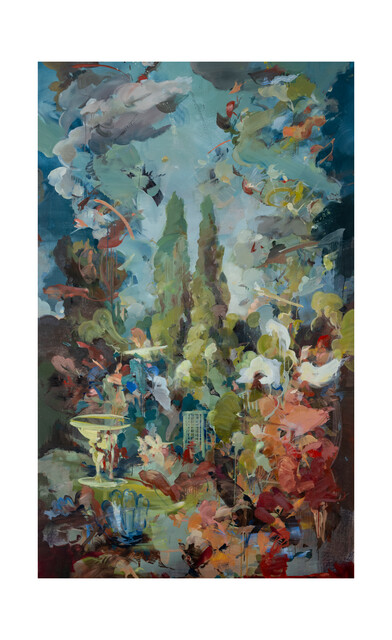
Eric Uhlir, born in 1979 and raised in Southern California, in his second solo show with Winston Wächter.
New paintings in oil on linen, large and small, built up with brushes and then cut back with scrapers and solvents. Titles include The warm and the cold and Once a favorite tree.
Uhlir is plain about his method: “I build the image up and take half of it back. This is my technique but also a reflection of how our memory works.” The paintings are about places and the people who loved within them. The real subject is the subtraction, what survives the scraper. The gallery has a good line for it: landscape and marriage, weather and memory, are “the same subject at different temperatures.”
Look for the passages where the blade went through to earlier layers. There the painting shows how it was made, which is also how it remembers.
Memory as subtraction: build the image up, then take half of it back.
Put the Kettle On
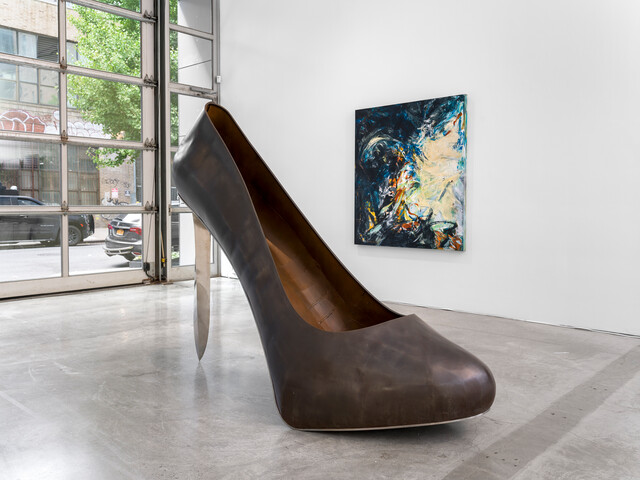
Gazelli Art House, founded in London in 2010, opening its New York gallery, more than 10,000 square feet on West 25th Street, with an eleven-artist group show.
Harold Cohen sits at the historical center. There is an ink drawing from his Drawing Machine period, Untitled (i23-3748), and there is Machine Painting Series TCM #4 (1995), made with dyes applied by his Painting Machine. Around him: Pauline Boty, Derek Boshier and Jann Haworth on mass media and visual culture; Lilly Fenichel’s gestural abstraction; and contemporary artists including Memo Akten, Jake Elwes and Brendan Dawes.
Cohen is the reason to come. AARON was among the earliest programs built to make drawings and paintings on its own. The works here sit on either side of a question that has only gotten sharper. If an artist writes the rules and a machine makes the marks, where does the authorship live?
The drawings point to Cohen’s answer: it lives in the rules, in the decisions about what a line may do and when it should stop. That is an old idea in art. Instructions get written by one hand and carried out by another, and the artist is whoever wrote the instructions. Cohen handed the instructions to a machine long before image generators made the question a headline. The show frames all of this as a gentle lineage. It works better as a test. Stand in front of the Painting Machine work first, then go to the contemporary pieces and ask which of them have rules worth reading.
The walk’s thesis at its purest: rules written by a person, marks made by a machine.
FLAVIA BACARELLA and RANI CARSON
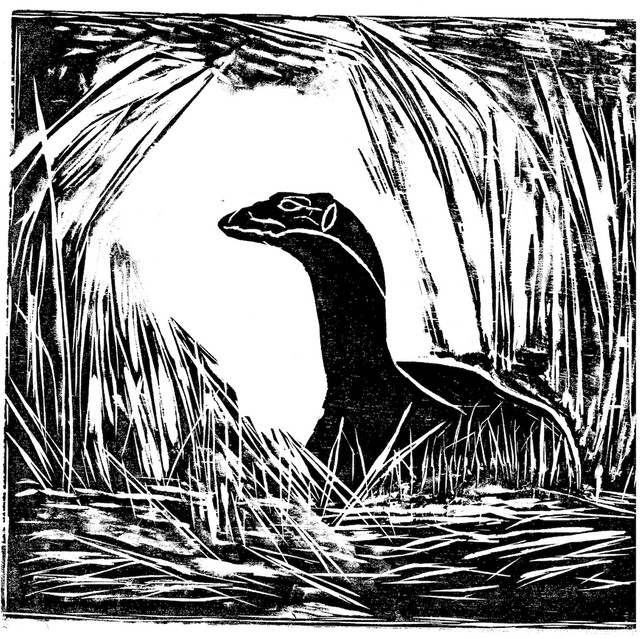
Prince Street Gallery, with two concurrent presentations: Flavia Bacarella and Rani Carson.
Bacarella’s woodcuts illustrate The Alone Trip: In the Wild Down Under, her husband Keith Stewart’s account of time alone in wild Australia, including his friendship with a monitor lizard. Carson’s new paintings, under the title Peaceful Protest, draw on Jamaica’s Rastafari community. Stewart gives an author talk at the gallery on October 24 at 3 pm.
Both bodies of work serve something outside themselves: a book in one case, a political stance in the other. On a walk otherwise about rules and the systems behind images, the change is useful. Here the image is in service rather than under examination. Of the two, the woodcuts and their monitor lizard are the bigger surprise.
Images in service of a story: the walk’s change of key.