01 A List of
Verbs
Benglis titles her survey with three verbs, and the walk around it follows them out the door: mesh knotted and pleated at Pace, a building’s louvre remade at Lehmann Maupin, one pour of paint a day at Berry Campbell, a key cut from a blank at Zwirner.
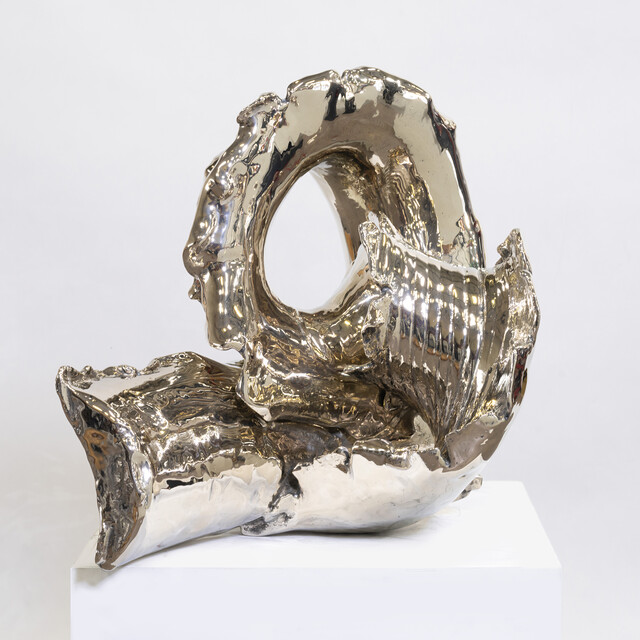
Lynda Benglis’s survey at Pace is titled with three verbs, Knotting, Tying, Folding, and the title is the method. Nothing in the show begins with an image. It begins with stock material from the hardware aisle, wire mesh and chicken wire, and an operation anyone could perform on it. The earliest piece, Sparkle Knot IV (1972), is a knotted tube of wire mesh covered in plaster, paint and glitter. The pleated wall works fold the same mesh into accordions and finish it in gold leaf or sprayed metal until the operation and the ornament are hard to pull apart. This walk follows that idea out the door, because three other shows on it are built the same way: a plain procedure, applied to an ordinary thing, and left legible. Rana Begum’s Louvre series at Lehmann Maupin starts from a part every building already has, the slatted panel of a vent or a blind, and remakes it in metal, stone and glass to see what it does to light. Susan Vecsey at Berry Campbell paints to a schedule: one pour of thinned oil a day on each canvas, a painting arriving over two or three months. Nate Lowman at Zwirner paints keys, the one object whose whole meaning sits in its cut profile. None of this is a shared style. What these artists share is a working habit: each lets the operation show. In every gallery the thing to look at is what was done, in what order, to what common material. Benglis and Lowman carry the argument hardest. Begum is the most architectural and the most dependent on daylight. Vecsey’s rule is the gentlest and asks for the slowest looking. First Street’s group show, observational painting with no rule in sight, works as the counterweight at the end.
- 01Nate LowmanDavid Zwirner · 519 W. 19th StreetCloses Oct 24
- 02Rana BegumLehmann Maupin · 501 W 24th StreetCloses Oct 24
- 03Lynda BenglisPace Gallery · 540 West 25th StreetCloses Oct 24
- 04In FocusBerry Campbell Gallery · 524 W 26th StreetCloses Oct 24
- 05MUSINGS | What is Seen and What is Not – Part IIFirst Street Gallery · 547 West 27th StreetCloses Oct 24
Lynda Benglis
Lynda Benglis, the sculptor whose poured latex floors of the late 1960s put gravity and the body into the work. Life magazine photographed her at work in its February 27, 1970 issue, and the comparison to Pollock has followed her since. A major retrospective opens at Kunstmuseum Basel in March and travels to Tate Modern.
Five decades of the same few operations. Sparkle Knot IV (1972) is a knotted tube of wire mesh in plaster, paint and glitter. The pleated wall pieces fold mesh like an accordion and finish it in gold leaf or sprayed metal. In the 1985 sand-cast glass fish, rarely shown, molten glass was bent and tied into knots, handled with Kevlar gloves and sticks in what Benglis calls "a play-dance activity." Elephant Necklace (2016) lays 37 black ceramic elements in a circle on the floor. And the recent bronzes are heavy: Striking Cobra (2020) weighs roughly 1,453 pounds.
The easy reading of Benglis is excess: glitter, gold, the body, the pour. The better reading is procedural. Knot, tie and fold are operations anyone can perform on a sheet of mesh. What she adds is a refusal to let the operation stay plain. Every surface gets pushed to an extreme; in her own words, her work “swings back and forth between extremes of coloration and texturing.”
The folds are there to catch light. Of the pleated works she has said that “the light, and the change of light, was a goal.” Walk past one slowly and the same pleat reads as two different surfaces, dark from one side and lit from the other. That is an architect’s lesson as much as a sculptor’s. A fold is the cheapest way to make a flat sheet stand up, and the cheapest way to put light to work. The show is worth the trip for watching one artist test that idea for fifty years in mesh, glass, clay and bronze without ever exhausting it.
The anchor and the template: three verbs applied to hardware-store mesh. Every other stop on this walk runs its own version of the same experiment.
Rana Begum
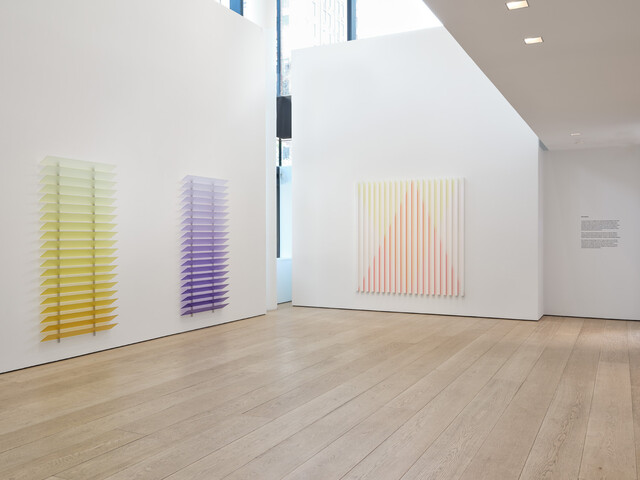
Rana Begum, born in Bangladesh in 1977 and based in London, in her first solo exhibition in New York.
Works from the Louvre series, remade in metal, stone and glass, alongside pieces from the Reflector series. Louvres are the slatted elements of ventilation panels, façades and blinds. The works are numbered rather than named, No. 1462 Louvre or No. 1473 L Reflector, like parts in a catalogue.
A louvre is a device for being partly open. It lets air and light through while blocking the view. Begum treats that small, everyday piece of building hardware as a subject. The gallery says the series came out of a decade of experiment and research, and that its theme is permeability.
That makes this the most architectural stop on the walk and the one most at the mercy of conditions. The gallery describes the works as “ethereal and elusive” at times, shifting “with changing conditions before resolving into more defined and solid forms.” Take that as an instruction. Look from an angle, then head-on, then come back when the light has moved. Benglis folds a sheet to make a surface. Begum repeats a standard part to make a filter. A louvre only reads as a louvre once there are enough slats, so the repetition is the point.
Benglis folds a sheet into a surface. Begum repeats a building part into a filter. The operation is the same and the purpose is the opposite.
In Focus
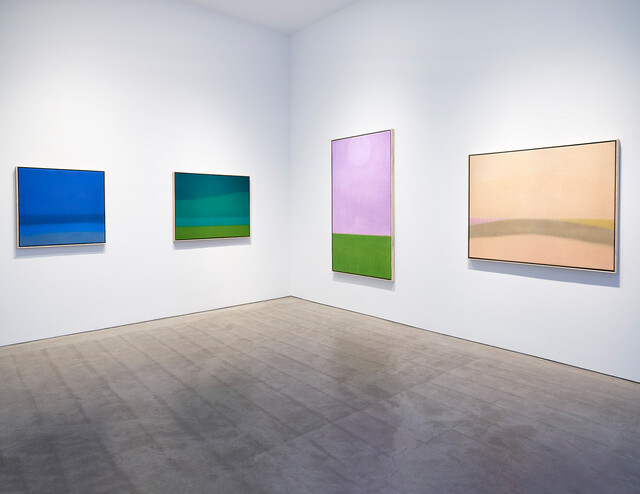
Susan Vecsey, known for lyrical abstraction drawn from nature. Her concurrent solo at the Pollock-Krasner House in East Hampton runs through December 13.
A focused group of recent paintings made by pouring thinned oil onto textured Belgian linen. The procedure is strict: one pour a day on each canvas, several canvases in progress at once, each painting developing over two or three months.
Poured abstraction usually gets described in terms of feeling: soak, glow, breath. Vecsey’s gallery describes a schedule, and the schedule is the better way in. With one pour a day, the painting builds up in layers, session by session. The texture of the linen, not a brush, has a large say in where each pour settles. The release says she works “responding to the character of the linen surface.”
The result is quiet, and a rule earned the quiet. Look for the edges where one layer sits over the one before it. Those edges are the days.
The walk’s gentlest procedure: one pour a day, kept on the surface as a record.
Nate Lowman
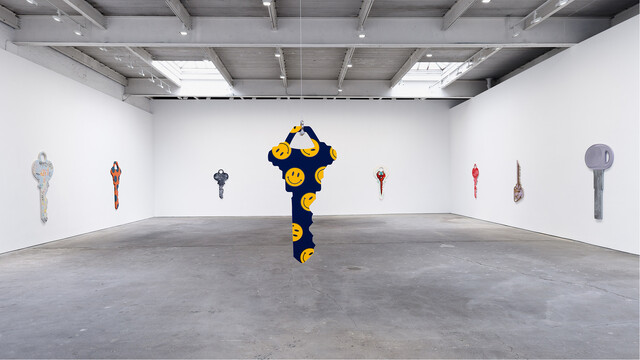
Nate Lowman, the painter known for serial shaped canvases: hearts, tree-shaped air fresheners, poppies, maps, each repeated with a different painted surface.
A new motif, shaped canvases in the form of keys, hung in a row. Some are tight replicas and some nearly abstract. Some carry Lowman’s own photographs, others the bright patterned finishes sold at hardware stores. One is the key to his current front door. Another reproduces a copy of their house key, patterned with a yellow-and-blue smiley face, that friends gave him in his early New York years so he would have somewhere to stay. A silkscreen diptych shows two keys not yet cut. The motif began with the memory of a late friend, the designer Benjamin Cho, and a dress he designed with holes and keyrings.
A key is a strange thing to paint, because all of its meaning sits in its outline. The bow is decoration and the cut is information. The release gets it exactly: each canvas is “a singular modification of a template, like keys themselves.” That turns the series into a working model of authorship in a reproducible system. The blank is standard, the cut is specific, and being copied is the whole point. The uncut diptych is the quiet center of the show: two keys before they open anything.
Then comes the harder line in the release. In a city where space is “precarious and increasingly out of reach,” a key is a kind of currency, and a whole economy of locksmiths and duplication shops exists because “a key exists to be copied.” The smiley-face key holds the show’s feeling. It stands for a door someone opened when he needed one, and it describes a New York that is getting harder to find.
The walk’s sharpest idea: a template, modified once, made to be copied, and the question of who gets a copy.
MUSINGS | What is Seen and What is Not – Part II
First Street Gallery, with eight of its gallery artists: Suzi Evalenko, Diane Fitch, John Lee, Rallou Malliarakis, Eve Mansdorf, Abbigayle Poirier, Nicole Santiago and Dana Saulnier.
The second half of a two-part show of drawings and paintings in a range of media: still life, nature and the figure, made from close observation.
This stop is a palate cleanser, not part of the walk’s argument. The release frames the work around “instinct and craft” and a “spontaneous response to the work as it progresses.” That is the opposite pole from the rule-bound work up the street. It’s worth a short visit for the contrast. Observational painting is a procedure too. It just hides its steps.
A counterweight: observation instead of operation.