Building for a World
Gates turns abandoned buildings into libraries. What does it mean to build for a community?
This walk stretches from Harlem to the Upper East Side — the longest route geographically, and the one that asks the biggest question: what does it mean to build for a world?
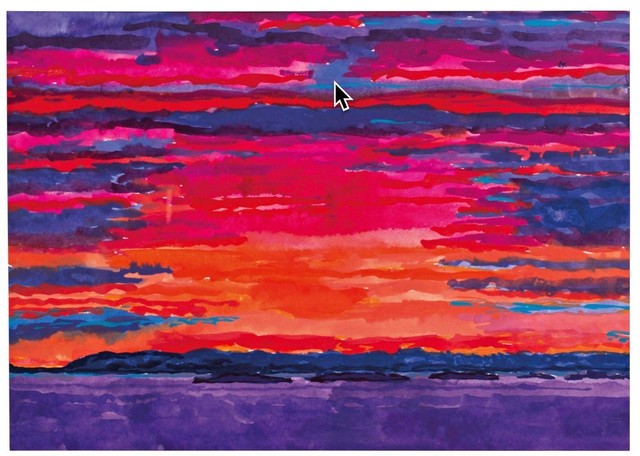
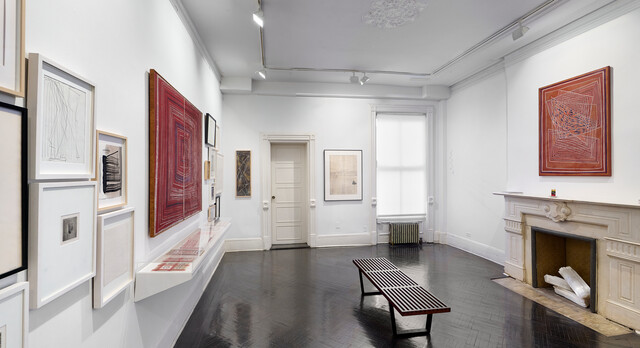
Start at Alpha 137 Gallery in Upper Manhattan, where 63 artists are gathered under the title *Landscapes, Cityscapes, Waterscapes and Skyscapes*. It’s an enormous group show — Frankenthaler, Hockney, Warhol, Serra, Twombly, Ai Weiwei — that functions less as a curated argument and more as a survey of how a century of artists looked at the places they inhabited. The sheer headcount is the point: this is the world as 63 people saw it, side by side, with no single voice dominating.
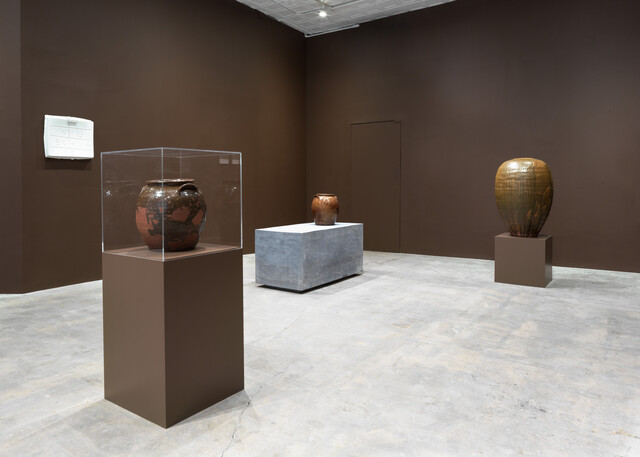
Then subway downtown to Gagosian Park & 75 for Theaster Gates. Gates buys abandoned buildings on Chicago’s South Side and turns them into libraries, archives, and gathering spaces. His work at Gagosian — *Dave: All My Relations* — brings that practice into the gallery context through ceramic vessels and sculptural forms that carry the weight of communal history. He’s the Heidegger artist on this walk: what does it mean to build, to dwell, to make space for a community rather than a market?
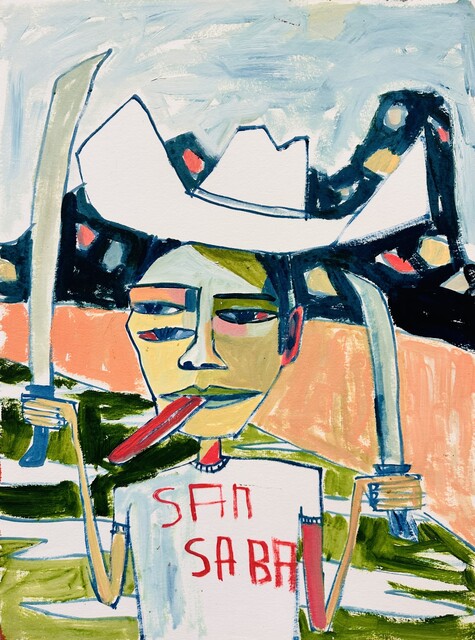
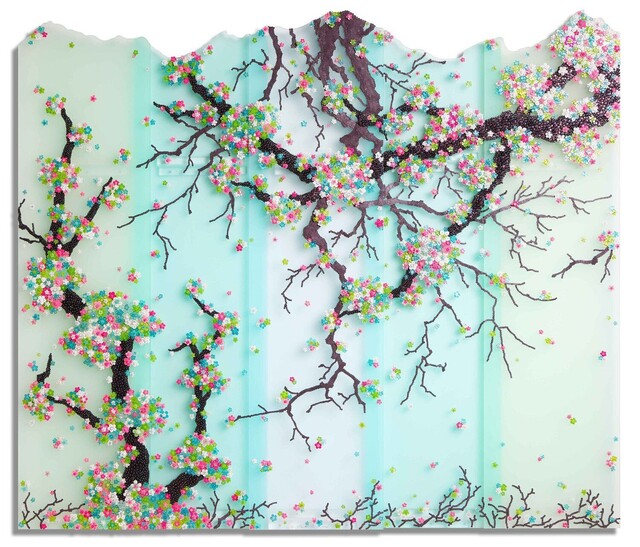
The UES galleries fill out the afternoon. Ruiz-Healy’s *Paper Trails* presents Latin American and Chicano artists working on paper — Rufino Tamayo, Francisco Toledo, newer voices. Leila Heller’s *Noble Blossoms* features Ran Hwang’s installations made from thousands of buttons and beads — meditative, labor-intensive, and drawing on Korean craft traditions. Henrique Faria’s *Reading Between the Lines* pairs Gego (the Venezuelan-German sculptor of suspended wire structures) with Myra Landau — both artists who make space visible by barely occupying it. And Sprüth Magers pairs Richard Artschwager with Gary Hume in a dialogue between American and British approaches to painting-as-object.
This is the itinerary for a day when you want to see how different artists answer the same question about place, community, and belonging — from a 63-artist survey in Harlem to intimate UES galleries where the conversation gets quieter and more focused.
Landscapes, Cityscapes, Waterscapes and Skyscapes
Not a solo show — a group exhibition of 63 artists spanning multiple generations and movements. The roster reads like an art-history syllabus: Helen Frankenthaler, David Hockney, Andy Warhol, Richard Serra, Cy Twombly, Alex Katz, Robert Rauschenberg, Ai Weiwei, Jeff Koons, Ed Ruscha. Alpha 137 Gallery in Upper Manhattan specializes in secondary-market works on paper and prints — this is a collector’s gallery that assembles constellations rather than launching careers.
Paintings, works on paper, and prints organized around landscape broadly defined — cityscapes, waterscapes, skyscapes. The show’s ambition is encyclopedic rather than focused: it wants to show you the range of ways that postwar and contemporary artists have depicted the world around them. At 63 artists, the experience is closer to browsing a collection than following a curatorial argument. The Christo works and Serra prints connect to the Land Art tradition that we’ve tagged in the taste profile.
The value of a show this large isn’t in any single work — it’s in the juxtapositions. A Frankenthaler stain painting next to a Hockney pool next to a Serra print creates a conversation about what ’landscape’ even means when each artist defines the term so differently. It’s family resemblance (§66) applied to a genre: these are all ’landscape’ works, but the family is held together by nothing more than the gallery’s framing.
The score is inflated (52.5pts) because the 63-artist roster hits multiple taste-profile matches. Editorially, this is a pleasant afternoon browse, not a must-see. But the Serra and Christo prints connect to the Heizer/land-art taste vector, and the sheer diversity of approaches to landscape is a useful counterpoint to the more focused shows on the rest of this walk. Think of it as the overture — broad strokes before the UES galleries go specific.
Theaster Gates
Theaster Gates is a Chicago-based artist who works at the intersection of sculpture, architecture, urban planning, and performance.1 His Rebuild Foundation has purchased and rehabilitated abandoned buildings on the South Side — turning a former bank into an archive, a former hardware store into a library, a former tavern into a gathering space. He’s not an architect in the licensed sense, but his practice is architectural in the deepest sense: he builds spaces for communities to dwell. Gagosian Park Avenue is his New York gallery.
*Dave: All My Relations* presents ceramic vessels, tar paintings, and sculptural assemblages that draw on African American vernacular craft, Japanese ceramics, and the material culture of the South Side.2 The ’Dave’ in the title refers to David Drake), an enslaved potter in nineteenth-century South Carolina who signed his vessels with poems3 — an act of authorship under conditions that denied his personhood. Gates’s ceramics carry that lineage: objects that assert presence and claim space.
Gates’s practice asks the Heidegger question directly: what does it mean to dwell? Not just to occupy space, but to make it meaningful through habitation, care, and communal use. His buildings aren’t galleries — they’re Lebensformen, forms of life. The ceramics at Gagosian are fragments of that larger project: objects that carry the memory of buildings, communities, and practices that existed before and will continue after the exhibition closes.
This is the Heidegger show. We haven’t started Building Dwelling Thinking yet (the reading plan is drafted, the first session is overdue), but Gates is the artist who makes that text urgent rather than academic. When Heidegger asks what it means to build-as-dwelling rather than build-as-production, Gates answers with actual buildings. Your professional life — designing computational tools that architects use to shape the built environment — sits at the same intersection. Gates works with his hands in clay; you work through software systems. Same question, different medium.
Paper Trails
Group show featuring Latin American and Chicano artists: Rufino Tamayo (Mexican master, died 1991), Francisco Toledo (Oaxacan polymath, died 2019), Cecilia Biagini, Celia Alvarez Muñoz, and others. Ruiz-Healy Art operates from San Antonio and New York, bridging Latin American modernism with contemporary Chicano practice.
*Paper Trails* focuses on works on paper — prints, drawings, collages — that trace a lineage of mark-making across Latin American and Chicano traditions. Tamayo’s rich, saturated color fields sit alongside Toledo’s intricate mythological drawings. The medium (paper) is deliberate: these are intimate objects, not wall-scaled statements.
Paper is the most intimate and democratic medium in visual art — portable, fragile, available. A drawing is closer to thinking-out-loud than a finished painting. This show lets you see the intellectual process behind these artists’ larger works.
Geographic anchor for the UES cluster. The intellectual thread is light but honest: the works-on-paper format connects to Close’s On Paper at Pace (different itinerary, same month), and both shows argue that the preparatory medium reveals something the finished work conceals.
Ran Hwang
Ran Hwang is a Korean-born, New York-based artist who constructs large-scale installations from thousands of buttons, beads, and pins hammered directly into the wall.4 Her process is meditative and labor-intensive — each piece requires weeks of repetitive manual work that she describes as a contemplative practice.
*Noble Blossoms* presents wall-scale installations of flowering branches made from buttons and pins. The images emerge from the accumulation of tiny, identical elements — each button meaningless alone, forming a recognizable image only in aggregate. The craft tradition is Korean but the visual result reads as universal: cherry blossoms rendered in industrial materials.
The accumulative method — meaning emerging from the repetition of small, identical acts — connects to both Close’s grid method and to the broader theme of this walk: building a world through sustained, patient labor. Each button is a dwelling act.
Geographic anchor + process connection. Hwang’s method — thousands of identical gestures producing an image that only resolves at distance — is another version of Close’s grid, translated into three dimensions and Korean craft tradition. The intellectual thread is the part-whole problem we’ve been tracking since §1.
Reading Between the Lines
Gego (Gertrud Goldschmidt, 1912-1994) was a Venezuelan-German sculptor known for suspended wire structures — ’Reticuláreas’ — that transform gallery spaces into three-dimensional drawings. She trained as an architect in Stuttgart before fleeing to Venezuela in 1939. Myra Landau (1926-2018) was a Romanian-Brazilian artist who worked across painting, printmaking, and drawing, with a focus on geometric abstraction and spatial investigation.
Reading Between the Lines pairs Gego’s wire drawings and small-scale sculptures with Landau’s geometric works on paper. Both artists investigate how line defines space — Gego through physical wire suspended in three dimensions, Landau through drawn line on flat surfaces. The pairing creates a dialogue between two immigrants to Latin America who made work about spatial experience.
Gego’s wire sculptures make visible what architecture usually conceals: the spatial relationships between things. Her Reticuláreas don’t occupy space so much as they reveal it — they’re diagrams of emptiness, making you see the air between the wires. For an architect, these are revelatory objects.
Gego trained as an architect. Her work translates architectural thinking into sculpture — structure, tension, spatial relationship, the organization of emptiness. This connects to the Heidegger BDT reading plan: Heidegger argues that space isn’t a container but a relationship between things. Gego’s wire sculptures are that argument made physical. Worth seeing before we start the text.
Richard Artschwager / Gary Hume
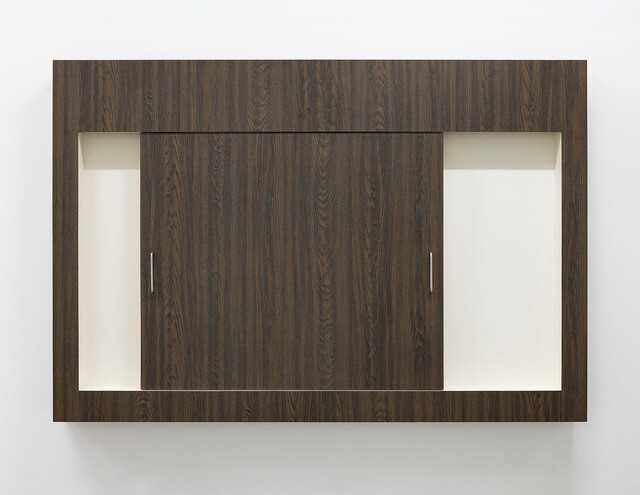
Richard Artschwager (1923-2013) was an American artist who blurred the line between painting, sculpture, and furniture. His work used Formica, Celotex, and other industrial materials to make objects that look like furniture but function as art (or vice versa). Gary Hume (b. 1962) is a British painter known for large-scale works in household gloss paint on aluminum panels — flat, graphic, seductive surfaces that refuse depth.
A two-person show pairing Artschwager’s hybrid painting-sculptures with Hume’s glossy aluminum panels. The dialogue is between an American who made painting three-dimensional and a Brit who made painting maximally flat. Both artists question what a painting is and where its edges are.
The Artschwager-Hume pairing is about the boundaries of categories. Is an Artschwager piece a painting or a sculpture? Is a Hume piece a painting or a design object? Both artists make work that resists classification — which is, again, the family-resemblance problem from §66: what holds ’painting’ together as a category?
Geographic anchor + category-boundary question. Artschwager’s furniture-as-sculpture is relevant to your architectural practice — where does the building end and the art begin? — but this is a lighter connection than the Gates or Gego shows on this walk.
- 1. Rebuild Foundation. Rebuild Foundation
- 2. Theaster Gates: Dave: All My Relations. Gagosian · 2026
- 3. David Drake's Poetic Pottery Was Resistance. National Gallery of Art
- 4. Ran Hwang: Noble Blossoms. Leila Heller Gallery · 2026