The Grammar of Making
Six ways of making, one question: where does meaning live?
Six shows on two blocks in Chelsea, five of them closing this week. What holds them together isn’t geography — it’s a question that runs through every room: where does meaning live?
Start at Lisson Gallery with John Akomfrah’s *Canto VI*. He doesn’t paint or sculpt — he gathers. Found footage, archival photographs, ambient sound, and staged tableaux, layered across eight screens in a 360-degree installation where there is no front and no back. The cantos are named after Pound’s method: fragmentary, multilingual, discontinuous. Meaning emerges not from any single screen but from the juxtapositions between them — colonial uprising next to women’s liberation, personal memory next to geopolitical rupture. You don’t watch it. You stand inside it and let it accumulate.
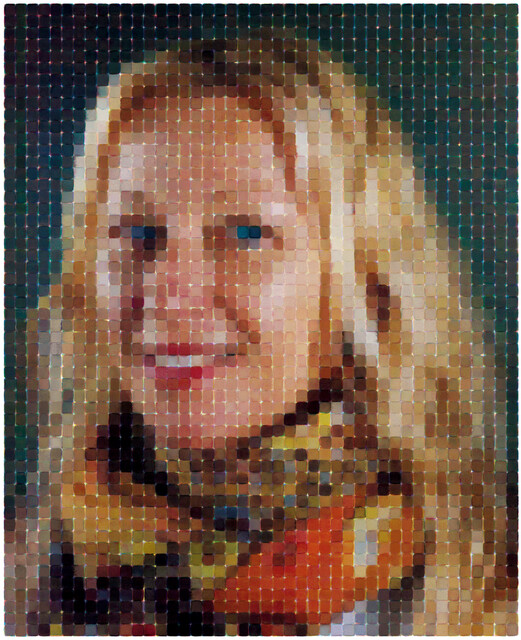
Walk one block to Pace and the register shifts entirely. Chuck Close built portraits from grids of abstract marks — each cell a small painting that means nothing on its own, but step back and a face assembles itself. It’s the part-whole problem made visible: meaning isn’t in the word, it’s in the sentence. Across the hall, Maysha Mohamedi waits. Her title comes from Singer’s *Gimpel the Fool* — a baker whose radical openness to the world looks like naivety but is actually a kind of kenotic wisdom. She lays hands on canvas and waits months for the painting to announce itself.
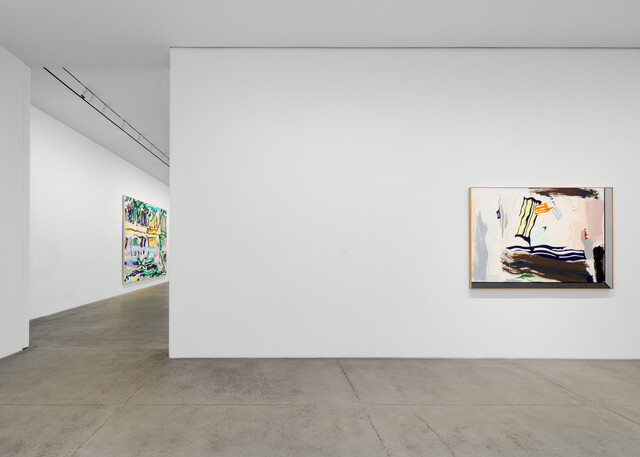
Then Gagosian, where Lichtenstein paints a picture of a brushstroke. The brushstroke — that sacred sign of authentic expression — rendered as mechanical reproduction, a Ben-Day dot simulation of spontaneity. It’s one of the great philosophical jokes in art history, and it’s doing exactly what Wittgenstein does with ’game’ in §66: showing you that the thing you thought was unified is actually a family of loosely related practices held together by nothing more than resemblance.
The walk ends at Gemini G.E.L., where *The Paula Cooper Effect* gathers nine artists whose work Cooper championed for decades — Judd, di Suvero, Cecily Brown, Sophie Calle. The show is about the gallery as a form of life. Cooper didn’t just display art; she shaped what New York was able to see. The gallery is a grammar, and her taste was its syntax.
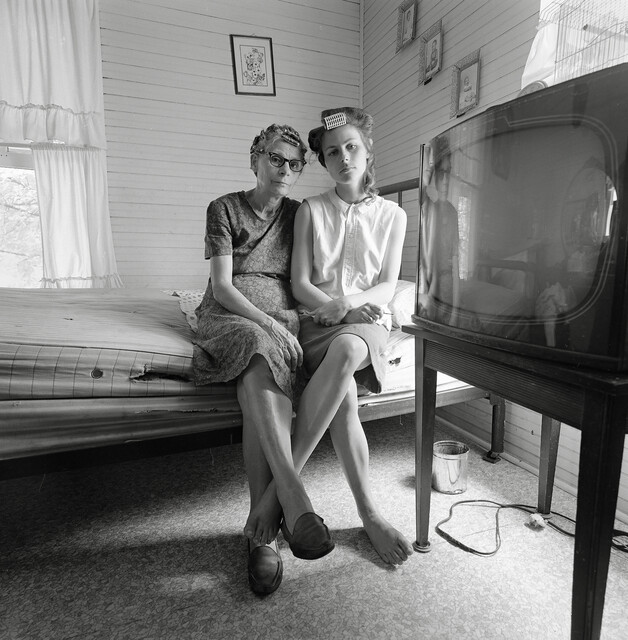
And tucked into the same block, Emmet Gowin’s *Baldwin Street* photographs — intimate, never-before-seen portraits of his wife’s family in rural Virginia, printed for the first time after sitting in his archive for decades. Gowin, who would later photograph nuclear test sites and Mount St. Helens from the air, began by looking at the people closest to him with the kind of sustained attention that most photographers reserve for landscapes. The dead-end street where Edith’s family lived becomes, over thirty years of return visits, a world.
Walk these six rooms and you’re walking through Wittgenstein’s central insight: meaning isn’t stored in the parts. It emerges in the use. Every artist here makes meaning differently — through montage, through grids, through waiting, through irony, through curation, through intimacy — and the differences matter more than any definition could capture.
John Akomfrah
John Akomfrah is a Ghanaian-British filmmaker and installation artist who co-founded the Black Audio Film Collective in 19821. His work lives at the intersection of documentary and poetry — archival footage, staged tableaux, and ambient soundscapes layered into multi-screen installations that resist linear narrative. He represented Britain at the 2024 Venice Biennale2. His lineage runs through Chris Marker, Harun Farocki, and the essay-film tradition, but his signature move is the canto structure borrowed from Pound’s *Cantos*: fragmentary, accumulative, where meaning emerges between the screens rather than on any single one.
*Canto VI* is the central multi-channel film from *Listening All Night To The Rain*, Akomfrah’s Venice Biennale commission now in its U.S. premiere at Lisson Gallery3. Eight screens across four walls create a 360-degree surround with no fixed front. The installation traces independence movements across Africa and Asia from the 1940s–70s — the Mau Mau rebellion, Congo’s struggle against Belgian colonialism, the Partition of India — interwoven with the parallel history of women’s liberation. Newly filmed material sits alongside found footage, archival photographs, and ambient sound.
Akomfrah’s method is bricolage — reusing diverse materials to produce new meanings. He doesn’t invent footage; he recontextualizes it. This is a direct challenge to the idea that meaning lives in original expression. The canto structure (Dante’s narrative unit reimagined through Pound’s modernist collage) asks whether fragments can stand for the whole. Akomfrah has described the work of assembling fragments as requiring ’an ethical and an aesthetic task of making narrative with those elements’4. That’s a philosophical claim about how understanding works — not through comprehensive coverage, but through juxtaposition that forces the viewer to make connections.
This is §1-10 made physical. We’ve been reading Wittgenstein on how meaning isn’t in the definition but in the practice of attending — Akomfrah builds an installation where meaning literally depends on where you stand and what you’re attending to. There’s no master view. His ’acoustemology’ (acoustic + epistemology: how listening shapes knowing) connects to our Heidegger dwelling thread — who gets to dwell? Whose memory gets housed? And his kenotic method — being permeable to everything, including history you didn’t live — maps directly onto the Easter conversation about suffering as participation rather than endurance.
Chuck Close
Chuck Close (1940–2021) revolutionized portraiture by treating the human face as a system. Starting in the late 1960s, he built monumental portraits from grids of abstract marks — each cell a small autonomous painting that resolves into a face only at distance. On December 7, 1988, a spinal artery collapse left him paralyzed from the neck down — he called it ’The Event’5. He continued working with a brush strapped to his wrist, shifting to Polaroid composites and inkjet prints. His late career reframed artistic agency: the question became not how to make a mark, but how to select which marks matter.
*On Paper* presents works spanning Close’s career, with emphasis on the paper-based process — drawings, prints, and works that reveal the grid system more nakedly than the finished paintings6. You see the infrastructure: the decisions about scale, color within each cell, the tension between local abstraction and global figuration. The show includes late Polaroid composites where the camera does the ’seeing’ and Close does the selecting — a language game about where artistic intention actually lives.
Close makes the part-whole problem visible. Each grid cell is complete in itself — an abstract painting with its own color logic — but means nothing as a portrait until you step back. This is the compositionality question from §1-10 rendered in paint: does meaning live in the word or the sentence? His post-paralysis work sharpens the question further. When the artist can barely hold a brush, what remains of ’the artist’s hand’? The answer turns out to be judgment, not dexterity — selection, not production.
You loved this show when you saw it last week — visible process, systematic commitment, the kind of conviction that doesn’t need to explain itself. Close’s grid is doing what we’ve been watching Wittgenstein do with language: decomposing something that seems unified (a face, a word’s meaning) into a family of discrete operations that only cohere in use. And his late work — after the body fails — raises the question you asked about §8: if the physical practice changes, does the meaning change? Close’s answer: the grammar survives the loss of fluency.
The Paula Cooper Effect
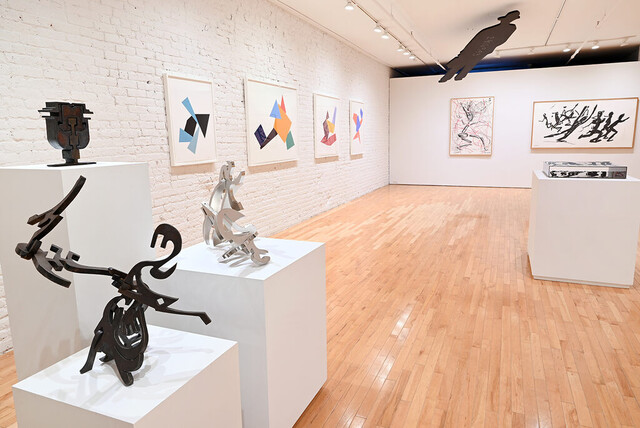
Paula Cooper opened her eponymous gallery in 1968 with a benefit exhibition for the Student Mobilization Committee to End the War in Vietnam7 — art and politics entangled from the first day. For over five decades, she championed artists who would define multiple generations of American art: Donald Judd, Carl Andre, Elizabeth Murray), Cecily Brown, Sophie Calle. This show at Gemini G.E.L. at Joni Moisant Weyl gathers prints by nine artists from Cooper’s orbit, curated to reveal not just the art but the ecosystem that made it visible8.
Prints and works on paper by Cecily Brown, Elizabeth Murray), Claes Oldenburg, Donald Judd, Joel Shapiro, Mark di Suvero, Jonathan Borofsky, Sophie Calle, and Robert Gober8. The medium matters: prints are the most democratic form of art — multiples, accessible, designed to circulate. Seeing Cooper’s artists in print form rather than major gallery installations shifts the scale from monumental to intimate. You’re looking at what these artists made when they were working for the page, not the wall.
The show is about the gallery as a form of life — Lebensform, the Wittgenstein term we unpacked in §2-3. Cooper didn’t just display art; she created the conditions under which certain kinds of art could be seen, discussed, valued, and understood. Her taste was a grammar: it determined what could be said. This raises the question of whether a gallerist is an artist — whether curation is creation. Cooper’s answer, implicit in sixty years of practice, is that the distinction doesn’t matter if the language game works.
Remember the §2-3 discussion where you noticed that the builder’s language is more efficient than the philosopher’s — and asked whether that efficiency IS meaning rather than a reduction of it? Cooper’s gallery practice is that insight made institutional. She built a language game (the gallery program) that was efficient, specific, and powerful enough to shape what an entire city could think about art. The gallery as Lebensform — not a building, but a form of life that makes certain conversations possible.
Maysha Mohamedi
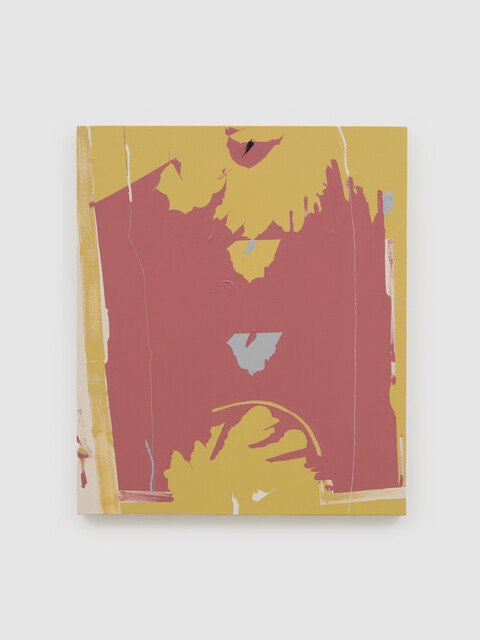
Maysha Mohamedi studied cognitive science with a specialization in neuroscience at UC San Diego (BS, 2002), then earned her MFA in painting from California College of the Arts in 20119. Her paintings emerge through a process of waiting: she lays pigment on canvas and returns over weeks and months, responding to what the surface reveals. She calls them ’divinations.’ The title of this show comes from Isaac Bashevis Singer’s *Gimpel the Fool* — originally published in Yiddish in 1945, translated by Saul Bellow for *Partisan Review* in 195310 — a story about a baker whose openness to the world looks like naivety but is actually transcendence.
*Maysha the Fool* presents large-scale paintings that hover between abstraction and something almost geological11. The surfaces are built up in slow layers — you can see the time in them. One painting is titled *I Don’t Mind What Happens* — a line from Jiddu Krishnamurti’s 1977 Ojai public talk12. The work has an unusual physical presence: Mohamedi often lays her hands directly on the canvas, and the scale of the paintings means you’re standing inside the gesture, not looking at it from outside. The show is intimate despite the scale.
The neuroscientist-turned-painter trajectory isn’t a curiosity — it’s a philosophical position. Mohamedi studied how the brain constructs visual experience and then chose to make work that refuses to construct anything. She waits for the painting to tell her what it wants to become. That’s a kenotic posture: receptivity as strength, not passivity. The *Gimpel* connection deepens it — Singer’s fool isn’t stupid, he’s radically open, and that openness is what allows meaning to arrive.
This connects directly to the Easter kenosis conversation — your shift from ’suffering makes us stronger’ (Stoic endurance) to ’being alive means feeling everything’ (kenotic participation). Mohamedi’s process IS that shift rendered as artistic method. She doesn’t impose meaning on the canvas; she makes herself available to it. The neuroscience-to-art bridge also maps onto your professional life at Autodesk — the question of what happens when someone who understands systems analytically chooses to work through intuition instead. Not abandoning the analytical, but letting it become background grammar.
Roy Lichtenstein
Roy Lichtenstein (1923–1997) was a founding figure of Pop Art who spent his career interrogating the gap between what art looks like and what art is13. Starting in the early 1960s, he appropriated comic strips, advertisements, and art-historical references, rendering them in his signature Ben-Day dot technique — a mechanical printing process used to simulate continuous tone. He took the most ’authentic’ gesture in painting (the brushstroke) and turned it into a mass-produced image, daring the viewer to explain why it shouldn’t count. The *Brushstroke* series) began in 1965 and became one of his most enduring bodies of work14.
*Painting with Scattered Brushstrokes* focuses on Lichtenstein’s brushstroke paintings15 — works from the 1990s where he scattered rendered brushstrokes across canvases like confetti. Each brushstroke is painted to look spontaneous but is actually meticulously planned — a simulation of expression, a picture of a feeling. The Gagosian installation at 541 W 24th gives the work room to breathe, and the scale of the late paintings (some over 10 feet) lets you stand close enough to see the dots and far enough to see the joke. The exhibition is drawn from the Lichtenstein family collection and accompanied by a fully illustrated catalogue15.
This is one of the great philosophical jokes in art history. The brushstroke is supposed to be the sign of authentic expression — the artist’s hand made visible, proof that a human was here. Lichtenstein renders it as mechanical reproduction, a picture of a brushstroke. He’s not destroying authenticity; he’s showing you that ’authentic expression’ is itself a concept held together by family resemblance, not by any essential quality. The scattered brushstrokes of the 1990s push this further — they’re decorative, joyful, and completely artificial. They dare you to enjoy them anyway.
Lichtenstein is doing exactly what Wittgenstein does with ’game’ in §66 — a section we’re heading toward in the reading. He shows you that the thing you thought was unified (the brushstroke as authentic expression) is actually a category held together by nothing more than resemblance. And your reaction to the Sagmeister show (‘trying so hard to be clever but falling flat’) is a perfect test case: Lichtenstein’s cleverness serves a real philosophical point; Sagmeister’s cleverness serves itself. The difference between wit and performance.
Emmet Gowin
Emmet Gowin (b. 1941, Danville, Virginia) is an American photographer whose six-decade career spans intimate family portraits and aerial photographs of nuclear test sites, volcanic landscapes, and industrial terrain16. He studied under Harry Callahan) at the Rhode Island School of Design (MFA, 1967) and taught at Princeton for over thirty years (1973–2009). His early work — radiant, circular-vignetted portraits of his wife Edith and her family — established a register of intimacy that the later aerial work never fully left behind. The tenderness in a photograph of Edith on a ladder in Virginia is the same tenderness in a photograph of Mount St. Helens from ten thousand feet.
*Baldwin Street: Photographs 1966–1994* presents portraits of Gowin’s wife Edith Morris and her extended family in Danville, Virginia, most never before exhibited17. Named after the dead-end street where the family lived, the photographs span nearly thirty years of return visits. Gowin unearthed and printed them between 2020–2022, looking back at images he’d made decades earlier with fresh eyes. The show coincides with a new Princeton University Press book on the series, and runs concurrently with AIPAD’s The Photography Show (April 22–26)17. The images are intimate, domestic, and suffused with a light that feels both specific and archetypal.
These photographs sat in an archive for decades — seen by the photographer, unseen by the world. What happens when you print a forty-year-old negative for the first time? The image hasn’t changed, but the photographer has, and so has the world that receives it. Gowin’s act of return — going back to his own archive as if it were someone else’s — is a form of philosophical attention. He’s rereading his own earlier work the way you reread a passage and find something new. The dead-end street becomes, over thirty years, a complete world.
This is the show that doesn’t have an obvious PI connection — and that’s why it matters on this walk. After five shows that are all, in different ways, about the construction of meaning (montage, grids, kenosis, irony, curation), Gowin offers something simpler: sustained attention to the people closest to you, over decades, without theory. It’s the Rilke question you haven’t answered yet — ’why just once?’ Gowin’s answer is: not once. Thirty years of the same street, the same faces, the same light. Repetition as a form of love.
- 1. John Akomfrah: Biography. Tate
- 2. John Akomfrah: Listening All Night To The Rain — British Pavilion, 60th Venice Biennale. British Council · 2024
- 3. John Akomfrah: Listening All Night To The Rain (U.S. Premiere). Lisson Gallery · 2026
- 4. John Akomfrah interview
- 5. Dyslexia, Paralysis, Face Blindness: Nothing Comes Between Legendary Artist Chuck Close and His Work. Brain & Life (American Academy of Neurology)
- 6. Chuck Close: On Paper. Pace Gallery · 2026
- 7. Benefit For The Student Mobilization Committee To End The War in Vietnam. Paula Cooper Gallery · 1968
- 8. The Paula Cooper Effect. Gemini G.E.L. at Joni Moisant Weyl · 2026
- 9. Maysha Mohamedi: Artist Biography. Pace Gallery
- 10. Gimpel the Fool — short story by Singer. Encyclopædia Britannica
- 11. Maysha Mohamedi: Maysha the Fool. Pace Gallery · 2026
- 12. J. Krishnamurti: Public Talk 2, Ojai 1977
- 13. Roy Lichtenstein — MoMA Collection. Museum of Modern Art
- 14. Brushstroke (Lichtenstein). Wikipedia
- 15. Roy Lichtenstein: Painting with Scattered Brushstrokes. Gagosian · 2026
- 16. Emmet Gowin: Artist Biography. Pace Gallery
- 17. Emmet Gowin: Baldwin Street: Photographs 1966–1994. Pace Gallery · 2026